In the News, Research Assistance

Research Assistance for The Palm Beach Post

Athletic field and a stadium were part of the main features of the original proposal of the Coral Gables campus in 1925.

Earlier this month we provided research assistance for a reporter from The Parm Beach Post. He had already researched our digital collections and found good materials on the early history of the Miami Hurricanes and the unfulfilled football stadium on the Coral Gables campus. I was able to provide additional materials from the Historical Photograph Collection, the Campus Architecture Collection, and the Office of the President Records.

Please go to the link below to read the thorough article on the past stadiums used the Miami Hurricanes as well as their new home in the blog story below.

A visual history of Miami Hurricanes football stadiums: from the Orange Bowl to Miami Gardens

In the News

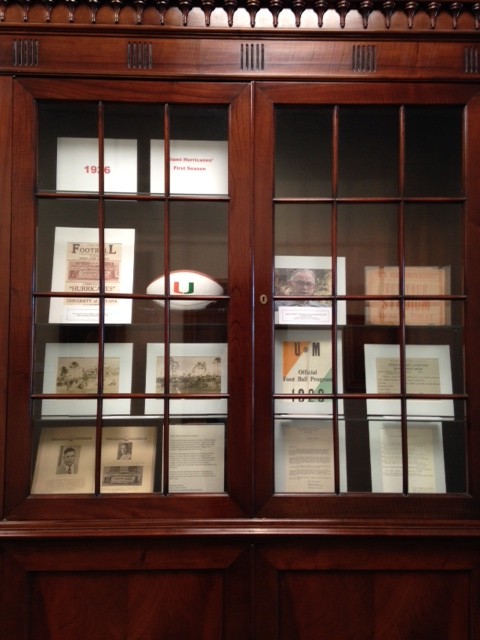
1926 ~ The Miami Hurricanes’ First Season

How did UM’s athletic program get started? What did the first team look like? Do you know how we came to adopt the name “the Hurricanes”?

With the fall semester and another exciting football season just around the corner, there’s no better time to explore the history of our team. A new exhibit from the University Archives features materials related to the Hurricanes’ first season, in 1926.

1926 football 1

The exhibit is located on the third floor of Richter Library, adjacent to the Presidential Portrait Gallery, which includes portraits of the five presidents of the University, from 1925 to present.

Sports history is one of the most frequently referenced topics at the Archives. In addition to directories and programs that have been donated to us by the University of Miami Athletics, resources such as the University of Miami Historical Photograph Collection, IBIS yearbooks, and The Miami Hurricane Archive Online (1927-2004) hold a wealth of information about UM sports through the decades. In the coming year, even more information on the subject will be available from the fifty linear feet of historical images, press clippings, and publications that were recently donated by the department.

1926 football  2

If you would like to learn more about the items on display in the exhibit or explore other topics related UM’s history, come by the University Archives, located on the 8th floor of Richter Library.

In the News

Special Collections and the University Archives: A Source for UM – and US – History

This summer’s issue of Miami magazine details the play-by-play course of events that led the University of Miami Hurricanes football team to take to the field against the University of Florida Gators in the wake of the 1963 assassination of President John F. Kennedy.  To move forward with the scheduled game was “a tribute to Kennedy,” writes Gasper González, in his feature story, Playing for JFK.  This poignant piece is well accompanied by images that ground it in its historical context, which set a stage for the reader that is truthful, credible, and, in this way, amplifies the story’s impact.

Special Collections Research Services & Projects Assistant Steve Hersh and University Archivist Koichi Tasa worked with Scott Fricker, UM’s director of creative services, to search, sort, and select fitting materials and publications from the time period referenced in the story.  The Archives’ assemblage of UM’s publications, photographs, and memorabilia served the need well, yet it was in Special Collections’ Orange Bowl Committee Archives that some of the more story-specific items were uncovered.  Mr. Hersh had to be especially resourceful in his search through these materials to narrow in on the precise time period.  The Orange Bowl Committee Archives are quite thorough and thousands of historical items deep, containing scrapbooks, photographs, programs, newspaper clippings, Committee meeting minutes, and many other objects and collectibles.

The UM Libraries have been working closely with University Communications to provide research assistance, high-resolution historical images for publications, as well as the technology and services necessary for the digitization and archiving of UM original materials.  Through partnerships such as this, UM’s history, and its niche in the global perspective, are made available and accessible to present and future generations of researchers looking to the past to tell their story.

In the News

“Throwback” with the University Archives

With only three days to spare until her deadline, Miami Hurricane Photo Editor Monica Herndon turned to the UM Libraries’ University Archives as the source for the August 29th issue’s Throwback Thursday theme. The cover story was a tribute to the 1983 National Football Champions, the University of Miami Hurricanes.

In the Special Collections Reading Room, University Archivist Koichi Tasa and his staff provided Ms. Herndon with several options and resources that included original old football programs and rosters, IBIS yearbooks, and UM history books. He then guided her through some of the Archives’ digital collections, such as the UM Historical Photograph Collection and The Miami Hurricane Archive Online.

Their search eventually led them to a collection of 35mm film negatives, donated by the University’s Department of Media Relations, and identified as being from the time of the championship. It was among those materials that Ms. Herndon found what she was looking for: a January 1984 image of the Hurricanes on parade through downtown Miami celebrating the Championship victory (above), and a photo of Howard Schnellenberger (below), the coach who led them to that accomplishment. The only problem was, the images were still on the Digital Production team’s queue to be digitized, and they were scheduled nowhere near the timeframe by which Ms. Herndon needed them for print.

Enter Digital Production Technician Marcelo Lopes, who Mr. Tasa states is “the hero of this story.” Mr. Lopes found a viable break in his team’s digitization workflow, shifted priorities accordingly, and was able to accommodate the high resolution scans just in time for Ms. Herndon’s deadline.

“The story was a success on several levels,” said Mr. Tasa. “It was a true collaboration based on need, available library services, dedication and commitment to the U.”