I am currently working for the first time to archive a collection of electronic records with my colleague Laura Capell, Head of Digital Production and Electronic Archivist. The commemorable organization of focus is UM’s undergraduate LBGTQ+ group SpectrUM. We will archive messages and e-flyers documenting their organizational efforts in support of UM’s lesbian, bisexual, gay, transgender, queer, and questioning community.
The collection was inspired by President Frenk’s December 2015 message on campus initiatives for inclusiveness towards LGBTQ+ students. I contacted SpectrUM to join their mailing list and have continued to save electronic records for the use of future students and researchers. We will make a decision shortly on how to provide access to the collection. For the time being, you can find more information on the collection in the finding aid.
SpectrUM, organized in 1992, has expanded on the work of The Gay Alliance, which formed in the 1970s.
Working on this collection made me wonder about earlier gay and lesbian organizations at the University. Some historical information is available in The Miami Hurricane Archive Online. There I found an article from 1985 titled “Gay Student Seeks to Inform” by Sal O’Neill. O’Neill, who was a senior at that time, wrote about an earlier group called The Gay Alliance, formed in the early-to-mid 1970s. “The Alliance had weekly rap sessions in the Alliance’s office in the Student Union. They also sponsored regular dances at the Rathskeller which were open to the public,” he writes, also noting significant challenges– “fears of exposure and violence, and the apathy that any group must contend with”–that brought about its demise. In the 1980s, students could connect in an off-campus group called the Gay and Lesbian Youth Group, which offered “emotional support and social interaction to gay men and lesbians not available elsewhere up to the age of 25.”
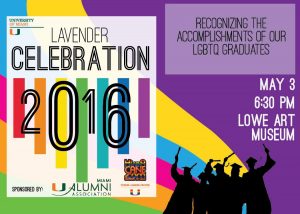
The Lavender Celebration 2016 was sponsored by the Division of Student Affairs, Student Life, Toppel Career Center and Alumni Association to recognize the accomplishments of LGBTQ graduates of the U.
This was before SpectrUM, which was organized in 1992 (under the name Gay, Lesbian and Bisexual Club). Its purpose is to foster pride through education, awareness, advocacy, and social events and to support all members of the LGBTQ+ community and their allies. It’s remarkable to see how far this mission has come, and we look forward to the opportunity of sharing its continuation with future students and researchers.
Stay tuned for announcements about future archival efforts. In an upcoming project in February 2017 we will work with groups such as the Black Alumni Society and United Black Students to curate a full exhibition at Richter Library on UM’s black students and faculty. The exhibition will coincide with the Black Alumni Society’s First Black Graduates Project. We look forward to collaborating with these and other campus organizations to honor their accomplishments.
We received another inquiry on the university seal, but today’s question was on the first seal of the U. I could tell right away the image the patron sent us was the first seal of the university, because we have already researched and identified the second and the third seal in last March!
*click here for the previous blog story on university seal
By researching our archival collection on UM seals, we found a document right away which gave the name of the designer and the dates it was used. With the name Hodsdon, I was able to find the February 4, 1944 article “Origin of Seal Now Revealed” in The Miami Hurricane Archive Online for the meaning of it. It is interesting the university ran a contest to pick the first seal.
This document in our archival collection on UM seals provided the name of the designer of the first sealMIami Hurricane, February 4, 1944 article “Origin of Seal Now Revealed”
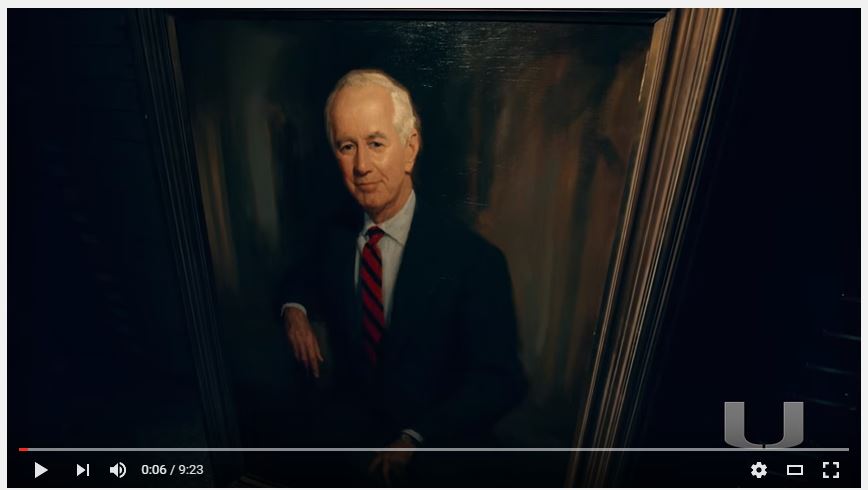
Official portraits of the past five presidents, which are kept at the University Archives, are one of the most important historical materials of the University of Miami.
The University Archives is proud to have provided research assistance and materials for the University Communications to create the compelling video “Tribute to President Foote.” Please go to the links below for the article and the video.
Two colleagues from the office visited us several times in April and spent hours to film our historical memorabilia, such as the Presidential Medal worn by the first four presidents and the official portrait of President Foote, as well as researched our vast collection of historical images for the project and for the Foote family, which are shown throughout the presentation.
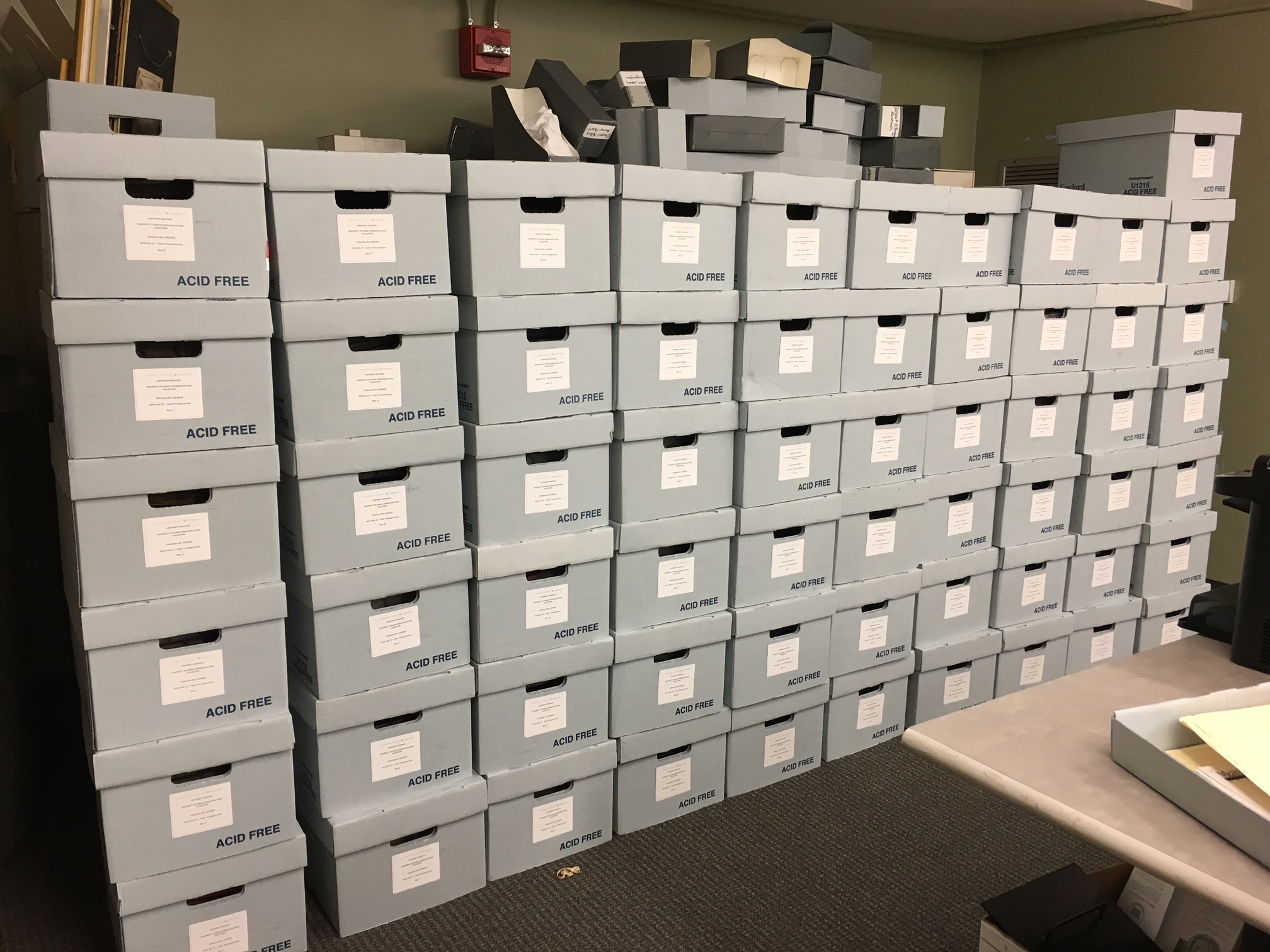
We used to tell patrons until recently that research assistance for Foote and Shalala years was not possible, but that is not true anymore because of the newly processed “UM University Communications Collection” in approximately 130 linear feet. You can expect a wide variety of materials in the collection, such as images, video recordings, university publications, and press releases generated by the University Communications on 4,000 topics from the 1980s to the 2000s.
This massive collection is going to be as important as the UM Historical Photograph Collection and UM Office of the President Records for the University of Miami when our patrons will research for U’s centennial celebrations as well as anniversaries and celebrations at the schools and departments of the university. We would like to thank the colleagues of the University Communications, who trusted us and let us archive their invaluable materials.
The collection, donated in 75 large moving boxes in 2013, is now neatly organized by approximately 4.000 topics and housed in acid free archival folders and boxes. Richter provides optimal environment for storage of our archival collections in the library as well as the offsite storage facility.
Our student assistant David Colbus’ historic visit to Dr. Butler took place on April 14, 2016.
By David Colbus, Senior in the College of Arts and Sciences
Student Assistant, University Archives
Two weeks ago, I took the opportunity to learn more about UM’s history by interviewing someone
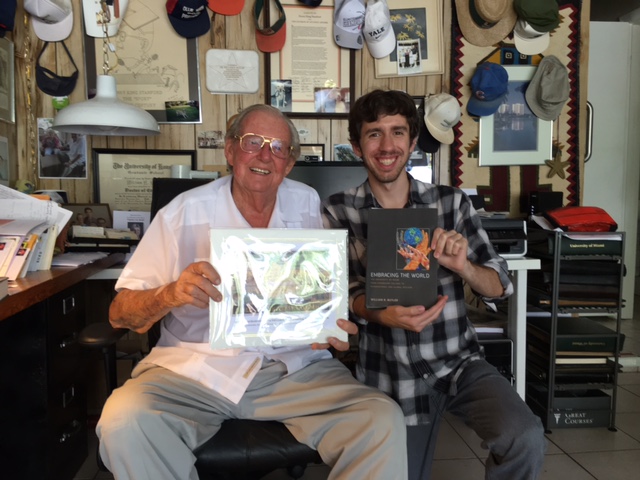
instrumental within it—Dr. William R. Butler. I knew I had found the former Vice President’s house when University Archivist, Koichi Tasa, and I saw the UM flag waving in front of his home. As we pulled into his driveway, Dr. Butler greeted us and invited us into his garage-turned-office. He immediately gifted us with several copies of his two books, and he even gave me my own signed copy of his 2008 book, “Embracing the World.” The Archives reciprocated Dr. Butler’s book gifts with a framed print of the “Keep Them Coming” poster which hangs in the library’s collection.
After this exchange, Dr. Butler invited us to sit with him. He began introducing the friends and
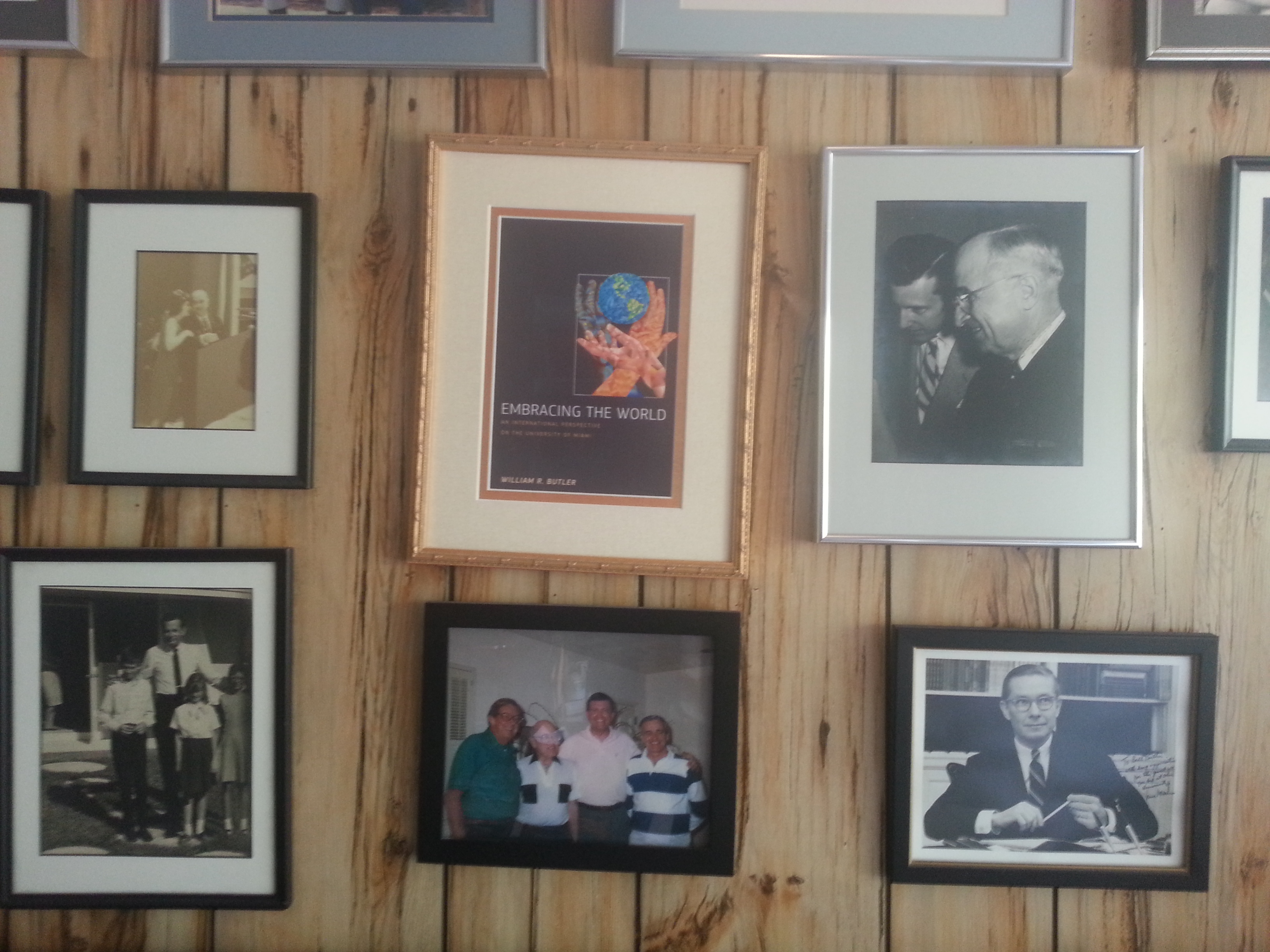
prominent people from the University of Miami and elsewhere that stood out in his gallery, including Presidents Harry S. Truman and Lyndon B. Johnson. When eyeing a picture of President Henry King Stanford, Dr. Butler told us the story of how the Butler family happened to come to the University of Miami. President Stanford telephoned him in 1965 while in his office at Ohio University when he was Dean of Students. He told Dr. Butler how impressed he was with the work he was doing with Ohio U students. He went on to say that a new position of Vice President for Student Affairs had just been established at UM and that he was interested in Dr. Butler filling that position. Dr. Butler was hesitant. He said, “My wife, Ginnie, and I are here at our alma mater. We love it here in Ohio and so do our four children. We have no plans to leave.” But President Stanford would not take no for an answer, so he flew Dr. and Mrs. Butler from Ohio to Coral Gables for a lengthy visit. Dr. Butler and his wife, Ginnie, fell in love with UM, and he accepted the position, serving as Vice President for Student Affairs for the next 32 years. “I loved every minute of my job,” Dr. Butler said. “My move from Ohio was something I have never regretted.” After finishing the tour of the gallery, Dr. Butler gave us a tour of his home, showing us the living room where he would invite UM students as guests to engage with the key guest speakers from the University.
When asked about his two books and his nearly 20 years of retired life, Dr. Butler joked, “I’m through writing books. The only book I have left in my thoughts is one which cannot be told.” Dr. Butler said he had been “enjoying his retirement years by writing books and getting more involved with the UM Alumni Association and the Butler Center for Volunteer Service and Leadership Development. I am also very involved in daily physical activity, and enhancing my network of friends from around the USA and the world.” He went on to say, “I have lived long enough to be able to do good things and help the less fortunate in life. And, I appreciate the positive effects and respect I’ve enjoyed for my efforts.” During his time as Vice President, Dr. Butler said that his philosophy of working with UM students was very simple—”students tell us if we listen.” He continued saying that he and his staff in student affairs believed that each and every student should grow to realize their full potential while studying and living at UM. Moreover, he has enjoyed taking a large private bureaucratic institution like UM and personalizing it for students. Dr. Butler is very proud of UM. During the past 50 years, the University has embraced his overall student-centered philosophy, something which only a few American research universities have accomplished.
When I asked Dr. Butler about President Tad Foote’s previous remarks on making the University “smaller and better,” he told me that UM has moved from essentially being the “state university of South Florida” to a very select private institution…one with smaller and better student enrollments and one with higher entry SAT scores. He elaborated, “Each of the past administrations has been able to build on the many accomplishments of the previous ones in building a research university of excellence.”
Dr. Butler took me through the history of the Student Volunteer Center which, in 1997, became the Butler Center. On his arrival in 1965, the Wesley Foundation on campus had a volunteer program named, Students of the University of Miami Move on Need (SUMMON). This program lasted only a few years because it was eventually taken over by Undergraduate Student Government and was discontinued during the early 1970s. Consequently, the SUMMON program ceased functioning. It was not until 1989 that Dr. Butler established the present volunteer services and leadership development center on campus. He is so proud of the accomplishments of the Butler Center, and he believes that each and every student should do something in life to help the less fortunate, without pay, with just the benefit of donating their services and leadership skills.
I then asked Dr. Butler about something I had read in his book, a phrase expressed by former President Henry King Stanford. Dr. Stanford had talked about his belief that UM had a “rendezvous with greatness.” He believed that this idea was a coming together, at an appointed time, when UM would achieve greatness in higher education. Dr. Butler added to this insightful idea when he stated that UM would enjoy an international rendezvous with greatness. He told me he believes that, not only will this international rendezvous occur, but in many respects it has already begun in recent years.
As Koichi Tasa and I were leaving, Dr. Butler gave me a list of what he personally has learned during his 90 years. What particularly struck me was the first item on his list—-“I believe in the three F’s….Family, Friends and Faith.” And, indeed, some of Dr. Butler’s friends had interrupted our interview a few times with telephone calls. Moreover, he encouraged me as well to call him from time to time. Quite happy, I returned to the UM Archives not with just UM’s historical facts, but also with copies of Dr. Butler’s books, his philosophical insights, and friendship.
*Please click here to read Dr. Butler’s essay “What I have Learned in Nearly 90 Years.” This document will be added to our archival collection of Dr. B’s personal papers “William R. Butler Papers.”
The walls of Dr. Buter’s office are covered with pictures of his accomplishments and souvenirs from all over the world.
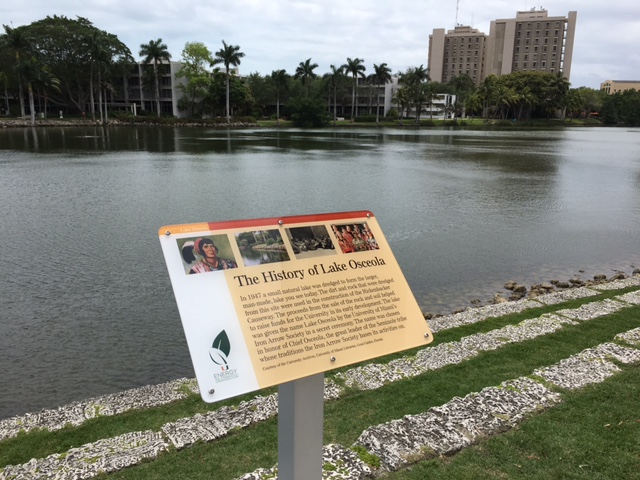
A colleague of mine just told me there is a new sign at Lake Osceola, which is informative and looks very attractive! We would like to thank the Energy & Conservation Organization of the University of Miami for the recognition they provided for our research assistance.

 I am currently working for the first time to archive a collection of electronic records with my colleague Laura Capell, Head of Digital Production and Electronic Archivist. The commemorable organization of focus is UM’s undergraduate LBGTQ+ group SpectrUM. We will archive messages and e-flyers documenting their organizational efforts in support of UM’s lesbian, bisexual, gay, transgender, queer, and questioning community.



 University of Miami Archives -- Let's Archive It