Events

Pan American University: The Original Spirit of the U Lives On

By David Colbus, Senior in the College of Arts and Sciences
Student Assistant, University Archives

Throughout last fall, the University Archives worked to curate and install the Pan American University: The Original Spirit of the U Lives On exhibit on Richter Library’s first floor. This was the first exhibit I encountered as a new University Archives assistant. To introduce me to the Archives’ work and purpose, my supervisor Marcia Heath gave me a tour of the recently completed display. The exhibit celebrates Pan Americanism, the University’s 90 years of history, and the new president, Dr. Julio Frenk. Beyond teaching me about my new role in the Archives, this exhibit educated me on the University’s history, and how that history informs the institution it is today.

2
“Pan American University: The Original Spirit of the U Lives On,” located on the first floor of the Otto G. Richter Library, features historical materials dating back to UM’s founding years. Photo by Andrew Innerarity.

The exhibit tells us that “Before there were University of Miami students or faculty, defined programs, or even a single building, the enduring concept of UM as the Pan American University had taken form.” Congressman William Jennings Bryan dreamed up this concept, one George Merrick and other founding members of the University strongly shared. Merrick envisioned a “university of our own tropical America…to supply that definite unfilled need of a cultural contact by university facilities with all of Latin America.” This Pan American University would invite cultural and academic exchange across all the Americas. This ideal informed the University’s earliest programs, research focuses, and even the University’s original architectural design. Victor and Rafael Belaúnde were specifically recruited to teach Latin American history and economics, and their establishment of the University’s Hispanic American Studies and Hispanic American Institute set the stage for many of today’s Hispanic-focused programs. The University of Miami also maintained close academic contact with the University of Havana through its early years to facilitate the academic exchange that Pan Americanism called for.
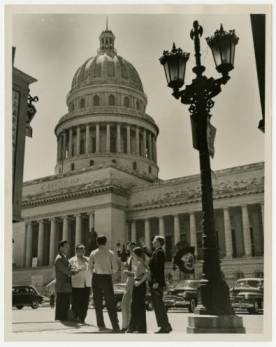
Drama_Department_members_in_front_of_the_Capital_Building_in_Havana
Photo featured in the exhibition of UM drama students outside of the capitol building in Havana, Cuba, c. 1950s, from the University Archives.

University Archivist Koichi Tasa came up with the vision for the exhibit and served as its chief curator, culling records from the Office of the President Records as well as visual materials from the UM Historical Photograph Collection and UM Campus Architecture Collection, among others from the University Archives. “It’s a great occasion to showcase our collections and knowledge about UM’s history,” Tasa said.

Archives specialist Marcia Heath worked with Tasa in research for the exhibit, and supervised the Archives’ assistants in their tasks. “We have an opportunity to start and frame important discussions about history, culture, and diversity in our community,” Heath said. “This resource encourages students to broaden their horizons.”

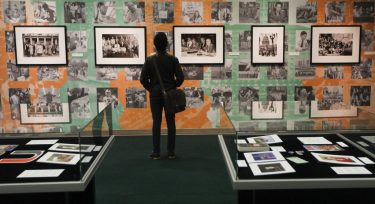
The exhibit was a collaborative effort within the UM Libraries and beyond: Beatrice Skokan and Yvette Yurubi from the Special Collections department and Meiyolet Mendez from the Cuban Heritage Collection researched and provided materials on topics such as the founding of Coral Gables and friendship between UM and the University of Havana. The Library Communications team provided editorial and promotional assistance for the exhibition. They also worked with local artist and UM alum Alex Vahan (Cushy Gigs, Inc.) in the creation of an eye-catching photographic collage surrounding the exhibition space.

Archives’ student assistants Jodiann Heron, Davin Stencil, Cody Andreoni, Sabrina Anand, and I located and researched materials for the exhibit. “What I really like is learning so much about the University. Every single day you learn something different,” Heron said. When I looked through the display cases, I remember being amazed by the complexity and importance of the exhibit. Yes, the exhibit focuses on the cornerstone idea of Pan Americanism and the University of Miami’s close ties to Latin America, following through the University’s creation and history, as well as into the modern day. However, it also locates one of the University’s greatest strengths, our diversity, within that original idea of Pan Americanism. It shows how the University’s devotion to broader understandings of cultural acceptance, of diversity, of peace and equality, stem from this one idea.
1
Local artist and UM alum Alex Vahan (Cushy Gigs, Inc.) created the historical wall design for the exhibition space using digitized archival materials. Photo by Andrew Innerarity.

This exhibit represents the University Archives in capacity and purpose, and represents its role they could play for the future. Looking forward to 2025, the University will be celebrating its 100th anniversary. The University Archives will play an integral role of this celebration, showing the growth and evolution of our University from the ideals that it was founded upon. I hope that all of the University of Miami, every department and office, helps us in this endeavor. “If anyone in the University wants to celebrate their anniversary, the Archives are here to work with them,” Tasa said. When the centennial celebrations arrive, everyone at this university, everyone who has contributed to its achievements and shaped its reputation, deserve to be celebrated as a part of that history, so that their efforts and accomplishments are remembered, and their spirit and ideals are passed on for those to come.

The exhibition “The Pan American University: The Original Spirit of the U Lives On” is on view on the first floor of Otto G. Richter Library through May 2016.

Events

University of Miami’s First Campus

anastasia building

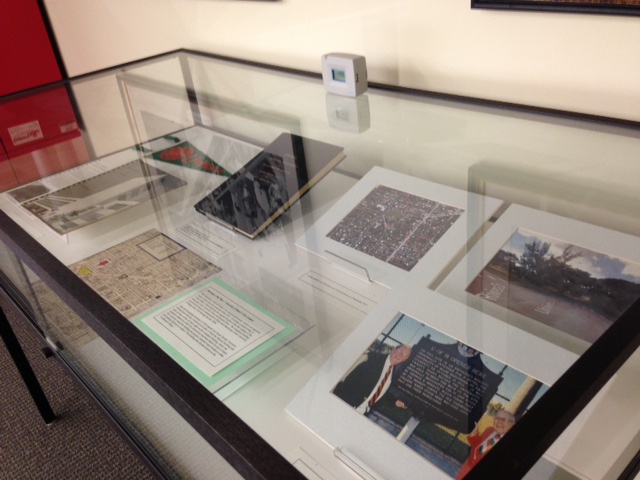
In coordination with the current Richter exhibition “This Space, This Place,” the University Archives is offering a mini exhibition titled “University of Miami’s First Campus” at the Special Collections Reading Room on the 8th floor of the library.

The featured item in the case is an appraisal report of the university properties from 1953. It contains a detailed map of Coral Gables that pinpoints the original location of the first campus of the university at the University Drive and Riviera Drive. The Anastasia Building was located there, which served as the home for administrative offices and classrooms of the University of Miami from 1926 through the late 1960s.

After the devastating hurricane of 1926 passed over South Florida, University officials knew that they would never be able to finish the Merrick Building and open on time, so they set their sights on the Anastasia Building, which was originally planned as a hotel but construction had been halted for lack of funds. The University leased the building and quickly installed room dividers to make the building function as a school. The building thus became known as the “Cardboard College.”

We hope this exhibition is going to be a good introduction for new students and employees to our collections and the university’s history and heritage.

exhibition case

Digital Collections, Events, In the News

Research on Diversity

Diversity is a very important research subject for us. The question keeps coming back several times a year with slightly different angles depending on who is asking for what kind of research project.

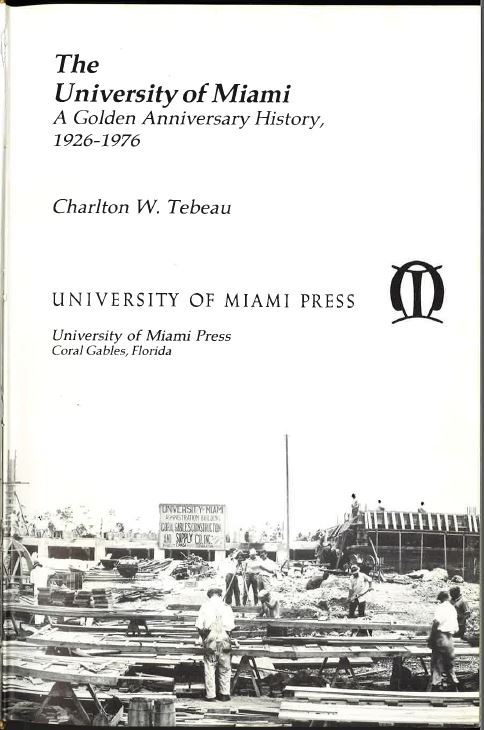
The publication we use most is a history book “The University of Miami: A Golden Anniversary History, 1926-1976” written by Dr. Charlton W. Tebeau, 1904-2000, who was a professor at the UM, Chairman of the History Department, and a prominent historian of Florida. The chapter 12 of the book “Desegregation, Integration, and Minority” provides a perfect overview of the subject with many interesting historical facts and images.

Title page of the book “The University of Miami: A Golden Anniversary History, 1926-1976”

The University of Miami: A Golden Anniversary History, 1926-1976 in Richter’s Online Catalog

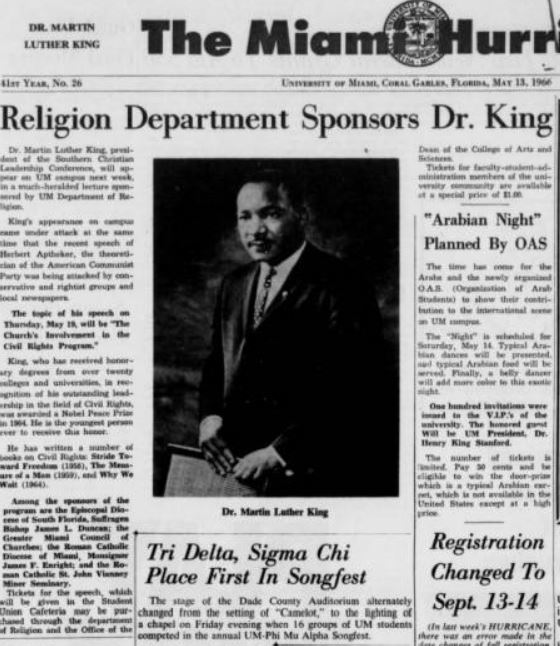
The Miami Hurricane, May 13, 1966 front page

The Miami Hurricane is also an excellent source for news and events on the subject. You could read articles on student protests on campus. Martin Luther King was invited to the University for a lecture in 1966.

The Miami Hurricane Archive Online, May 17, 1968 article on student protest

The Miami Hurricane Archive Online, May 13, 1966 article on Dr. King visited the university

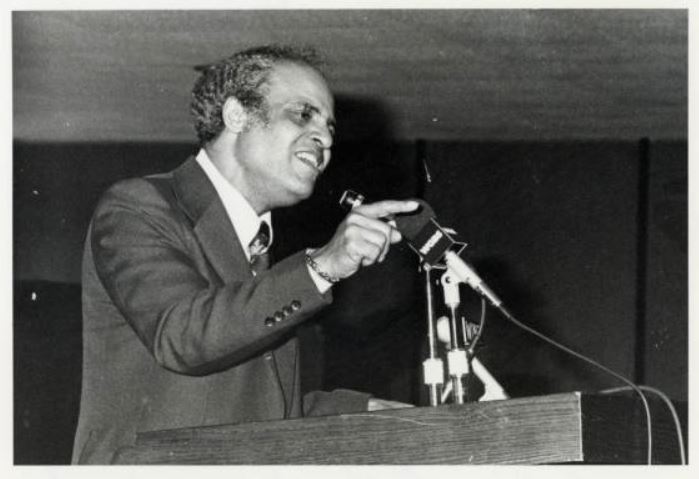
Benjamin Hooks, NAACP Executive Director, speaking at Black Culture Week

The UM Historical Photograph Collection can offer you effective visual images related to the subject, such as Dr. King’s memorial service held on campus in spring 1968 and the Black Culture Week held on campus in the 1970s.

Historical images taken at the Black Culture Week in the 1970s

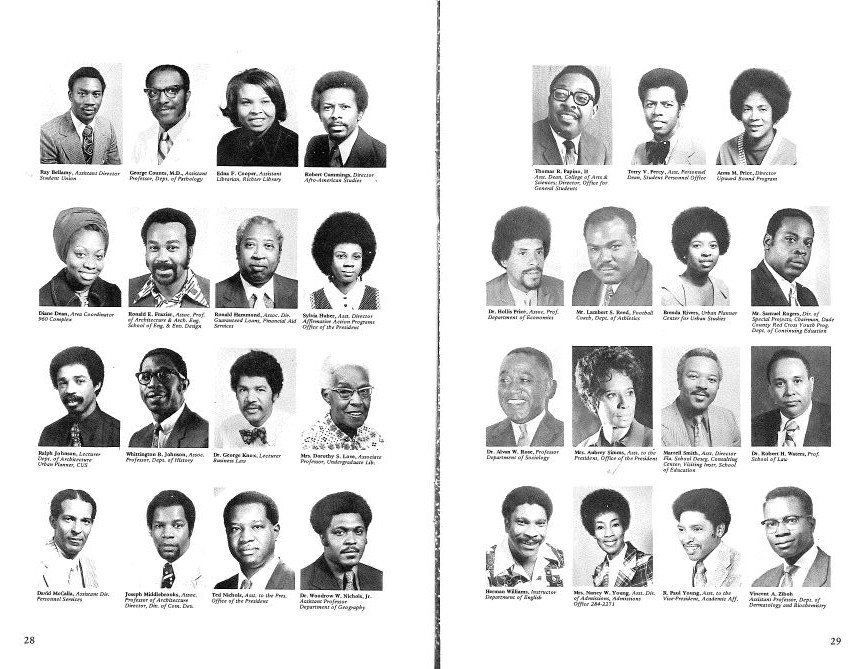
List of black facluty found in the 1974-75 Malaika Handbook

Also, we hold a collection titled “Malaika” published in the 1970s and 1980s by the United Black Students of the university. I used this collection recently for a patron who was looking for pictures of black faculty in the past. We would love to archive additional materials like this one if available.

Malaika, handbook written by and for the Black Students and faculty of the University of Miami, 1972-1985

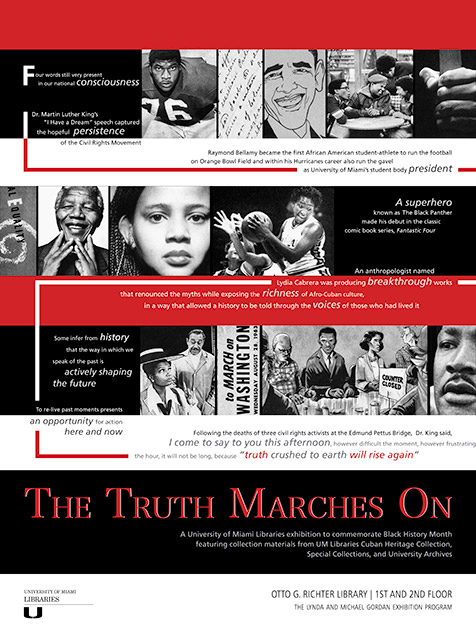
Richter's exhibition Truth Marches On

Richter’s exhibition Truth Marches On

Lastly, we would like to tell you we were proud to be a part of the research and exhibition effort for the Black History Month Exhibition held at the library for the first time this year. Please go to the link below for the subjects and exhibits presented at the exhibition. This wonderful website was created by my colleague Natapol Phensiriphand, Information Specialist, Education & Outreach department.

Themes and exhibits presented at Richter’s Black Heritage Month Exhibiton

Events, In the News

The exhibition is on e-Veritas

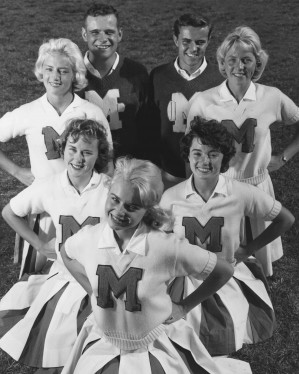
In University Archives, cheerleaders from another era sport an M rather than the now-familiar U.

Southern Suns and Sky Blue Water Showcases Student Life Over the Decades

University of Miami Libraries University Archives’ exhibition, Southern Suns and Sky Blue Water, is on display through January 2014 at the Otto G. Richter Library, and features photographs, fanfare, memorabilia, and publications that reflect student life at the University during the 1960s, 1980s, and early 2000s.

“There is a vibrant history here at UM,” says Koichi Tasa, University archivist and the exhibition’s lead curator. He notes that the exhibition’s title, the first line of the University’s Alma Mater, alludes to the timeless backdrop that unifies University athletics, student activities, and campus events across many generations.

Among the exhibition’s ’60s generation mementos is a vintage photograph of soul music pioneer Ray Charles performing at the UM Homecoming Concert in 1963, just two years after the University officially desegregated the campus. Research Services Supervisor Marcia Heath, a curator of the exhibition, said that Charles’s performance was a catalyst in raising morale among the student body during the racially charged period.

“These materials really show us where we’re coming from…how far we’ve come,” she said, also referring to the transformation in the University’s physical campus. One 1962 photograph of the Richter Library shows the completion of the main floors and stacks addition, which earned a design award by Florida Architect in 1964. The library now houses a print collection of more than four million volumes.

The exhibition, also curated by Education and Outreach Librarian William Jacobs and Special Collections Research Assistant Steve Hersh, includes IBIS yearbook spreads chronicling the evolution of traditions like Carni Gras, where students in the ’60s and ’80s strutted in high gear to embrace the Carnival spirit.

The exhibition even houses traditional fanfare such as a dink, once-required headgear freshmen sported until Miami’s first touchdown, and then tossed into the air. “Like the world, the University is changing daily,” said Cynthia Cochran, director of alumni programs. “The opportunity to visit some artifacts from those periods only enriches [alumni’s] visit back to campus, for some of whom it has been 50 years.”

Since he started at the University Archives in 2007, Tasa has worked closely with the UM Alumni Association. In 2010 artist Jacobina Trump created a mural at the Alumni Center, inspired by collection materials, conveying an unchanging horizon over the many generations to walk the campus. Like the exhibition, it also bears the words Southern Suns and Sky Blue Water. “Those words hit home for us all,” Tasa said.

Posted on 06 December 2013

Events

Playing History Detective

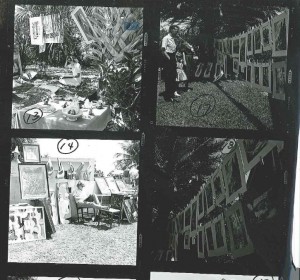
Last week, I researched the origin of Beaux Arts Festival of Art, which is a well-know annul outdoor art event on the Coral Gables Campus. The organizer has created a beautiful website, which describes the organization, the event, and its history. Yet, a researcher contacted us looking for original materials on the first Festival took place in 1952.

I was able to find a Miami Herald article dated May 4, 1952 on the first Beaux Arts Festival in the Beaux Arts Scrapbooks. I also found several images on 1952 Clothesline Art Sale in the Historical Photograph Collection. (contact sheet and negatives only available, please see the image below).

The only information available for the images is the caption “Clothesline Art Sale” and the year 1952 written in pencil on the back of the contact sheet. We cannot identify the names of the artists or customers in the images. But, this is still a wonderful discovery for me.