The fact books provide the most reliable benchmark data about the University.
We are pleased to announce the completion of a digitization project of another invaluable publication of the University of Miami, the entire run of the “Fact Books,” produced by the University of Miami Office of Planning, Institutional Research, and Assessment (PIRA).
The fact books provide the most reliable benchmark data about the University, such as student enrollments, retention and graduation rates, degrees granted, class sizes, library statistics, tuition and expenses, research funding, financial highlights, and endowment statistics. They are also an excellent source of information about the University’s history, administration and facilities, student life, and athletics.
The best way to research the collection is to browse the volumes one by one. Please click the icon “Browse All in this collection” at the landing page (link below) to access the digitized fact books. Once you have selected the volume you need, click the “Download” icon on the upper right corner of the screen, and select “All (PDF)” to save the file on your computer.
The digitization project of the Fact Books was made possible by an interdepartmental collaboration among the University Archives, Digital Production, Metadata & Discovery Services, and Web & Application Development at the Otto G. Richter Library.
We were excited to receive over 360 blueprints of the residence halls, which my Campus Planning & Development colleague has not seen before.
Two months ago we were delighted to receive a phone call offering over 300 never-before-seen architectural blueprints of UM buildings from the 1960s. They are plans of the UM’s residence halls designed by the Miami firm Connell, Pierce, Garland, and Freeman in 1967 and 1968. The donor of this wonderful gift is Mr. Lorenzo Otero Jr., a retired architectural draftsman, who studied at the University of Miami in the 1950s and worked for several architectural firms in Miami for four decades.
We appreciate very much the kindness of Mr. Otero’s two grandsons, Benjamin and Brian, who brought us the huge pile of the drawings in the rain saying that “we did not want to throw them away because we thought they could be valuable for the University.” They were very happy to find out that we would create an inventory list of all the drawings donated, preserve them with a help of Richter’s Preservation and Conservation specialist, and make them accessible for the University and the public.
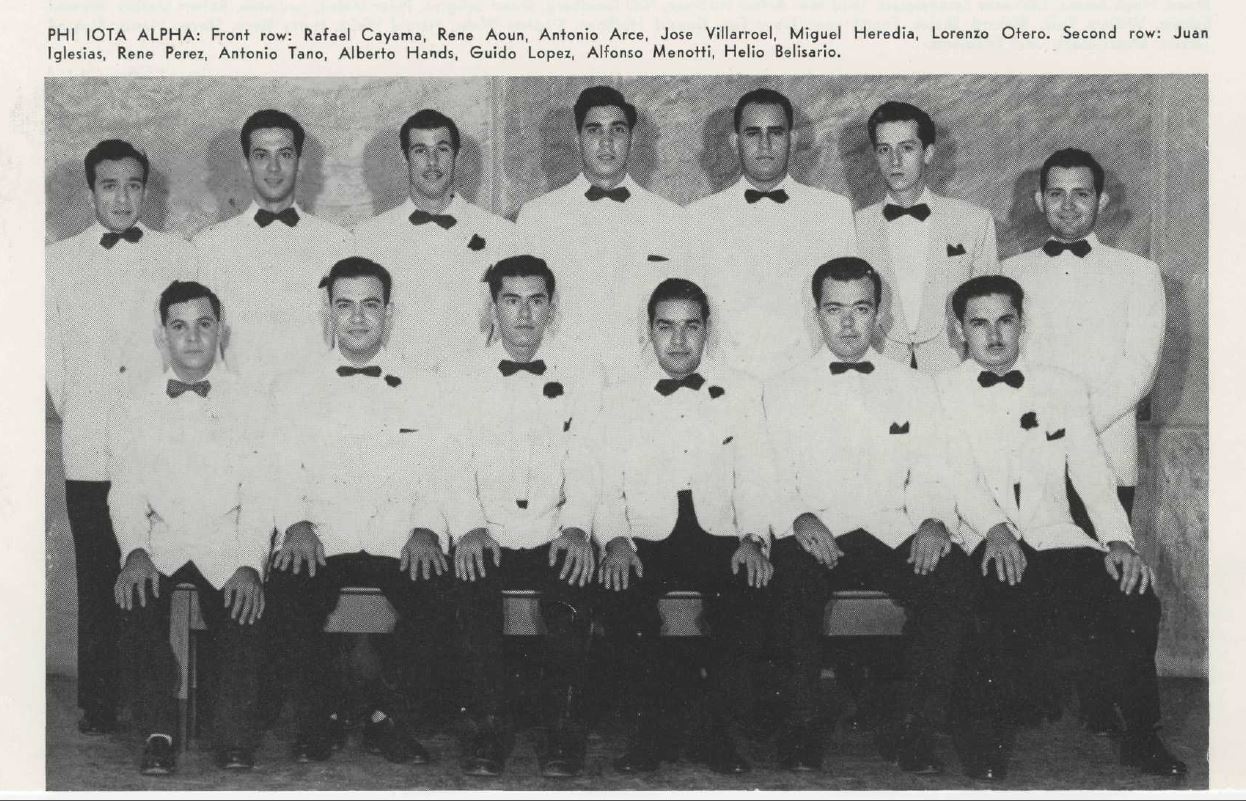
I would like to share with you a picture of Mr. Otero when he was a Cane. I also looked up Mrs. Otero (maiden name Sylvia Masson) because the brothers told me their grandparents met when they were students at the U. Below please see their pictures from the 1952 and 1955 Ibis yearbook.
Meet Mr. Lorenzo Otero, Jr. in the lower right corner of the group photo fond in the 1955 Ibis yearbook.Meet Mrs. Sylvia Otero in the lower right corner of the group photo found in the 1952 Ibis yearbook. You can also see her graduate portrait (1954 yearbook) as well as her name in the Spring 1955 commencement program.
Architectural drawings, blueprints, and historical images of the University of Miami’s buildings are important components of the University Archives. The collection has been developed in close coordination with UM’s Campus Planning and Development Office, and it has provided excellent materials for our exhibitions, University’s anniversaries and celebrations, and the School of Architecture’s faculty and students. Please go to the links below to find out more about the collection.
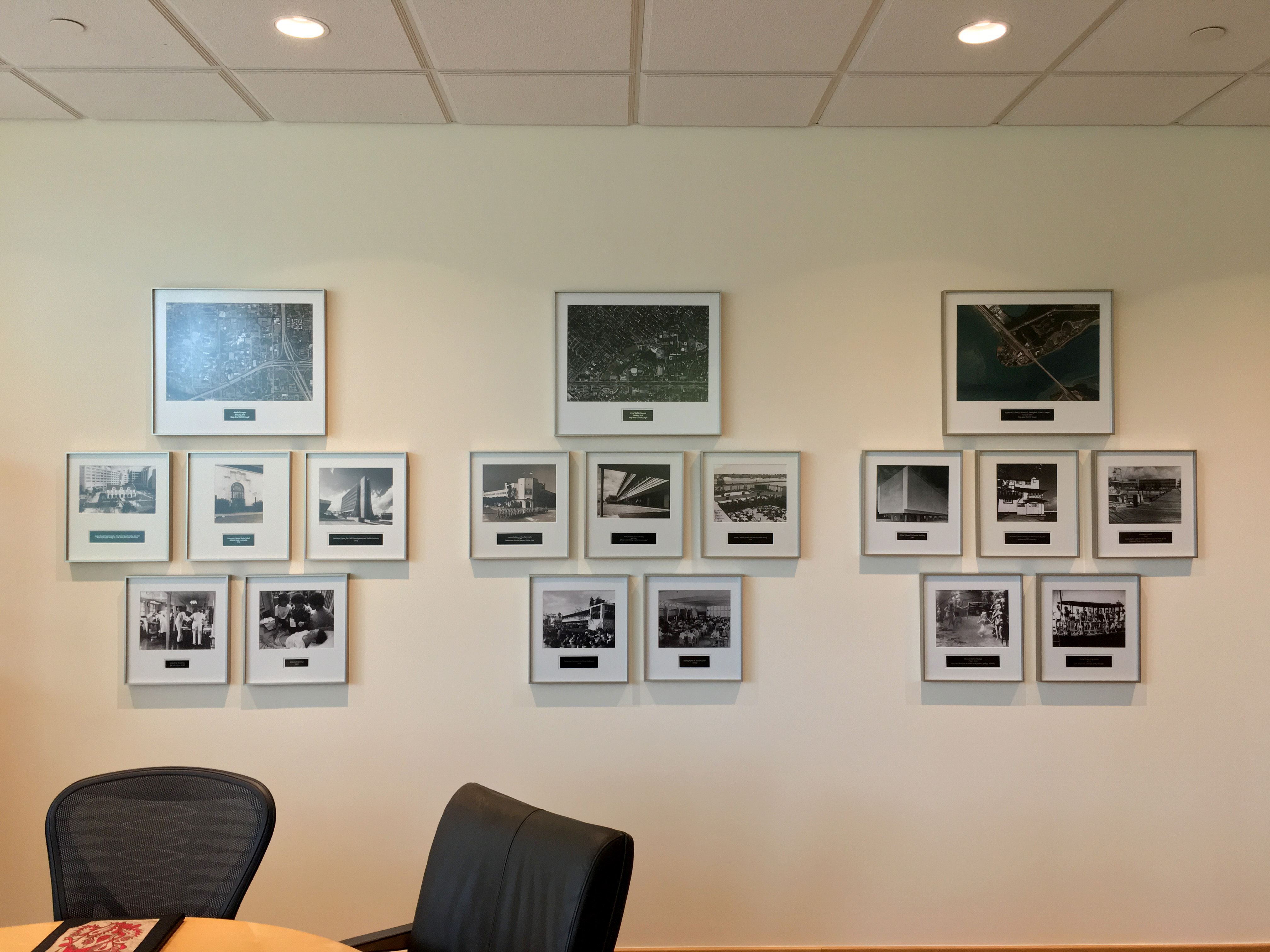
Three clusters of historical images represent Medical, Coral Gables, and RSMAS campuses (left to right)
The University Archives was delighted to provide research assistance and high-resolution images over the last summer for the Campus Planning & Development colleagues, who were asked to select iconic images of the University of Miami to decorate President Frenk’s office. Please see the three clusters of the images selected by the Office that represent the Medical Campus, Coral Gables Campus, and RSMAS Campus (left to right).
We hold more than half a million images of the University from the 1920s to late 1970s. A small portion of the collection (approximately 78,000 images) was digitized and made accessible to the public in 2010 at our website UM Historical Photo Collection for the first time. Today, you can see those historical images everywhere at several prominent places on the Gables campus as well as in many University publications.
Lots of colleagues in the university know we are good at “old” stuff, but soon we will announce a new massive collection of more recent materials from the 1980s to the early 2000s, which was donated by the University Communications in 2013. The collection contains images, videos, publications, and press clippings, which will be a tremendous help for the schools and departments to research their organizational history. Please contact us for further assistance for the new collection.
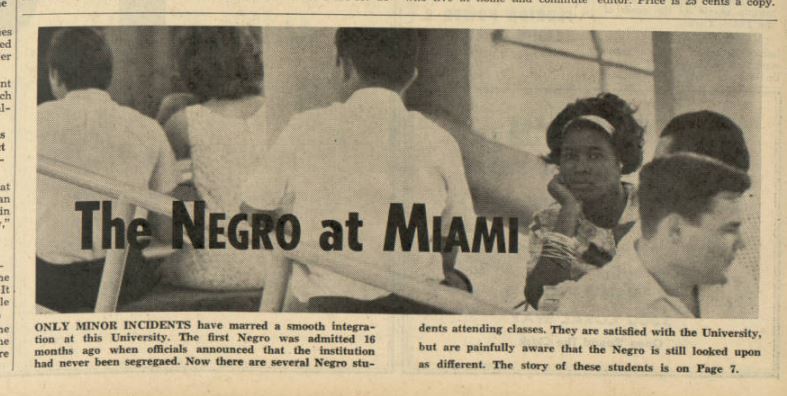
Miami Hurricane, October 26, 1962 article “The Negro at Miami”
Before 2010 patrons could not browse or research the archived issues of The Miami Hurricane (TMH) remotely. They had to visit the library, request bulky bound volumes of THM, and flip through the stories page by page. Also, they were encouraged to use the microfilms to save the rapidly deteriorating old original issues.
It was fall 2010 Richter had 1927-2002 content (approximately 2,900 issues, 42,000 pages) professionally digitized from microfilm and offered it to the public for the first time. Since then, Richter’s Digital Production team has added new issues provided by the past editors of THM in PDF as well as scanned old issues unavailable on microfilms, such as 1934-36 and 1963 issues and added them to the database.
So, what have we missed in the 1962-63 content? The other day I was touched by the October 26, 1962, article titled “The Negro at Miami” (front page and p. 7, link below), which reports the names and some faces of the first black students as well as their experience during the first year of integration at the U. This is a great discovery for the Black Alumni Society, which has been researching our collections to identify the first 500 black graduates from the 1960s and the 1970s. Click here to read the article.
TMH is one of the most important historical resources of the University, and the digitized content has been accessed by tens of thousands of patrons monthly since 2010. We appreciate very much TMH’s past editors for archiving with us. Also, we would like to thank our colleagues at Richter in Digital Production, Metadata & Discovery Services, and Web & Emerging Technologies for making the digitized content accessible online.
I am currently working for the first time to archive a collection of electronic records with my colleague Laura Capell, Head of Digital Production and Electronic Archivist. The commemorable organization of focus is UM’s undergraduate LBGTQ+ group SpectrUM. We will archive messages and e-flyers documenting their organizational efforts in support of UM’s lesbian, bisexual, gay, transgender, queer, and questioning community.
The collection was inspired by President Frenk’s December 2015 message on campus initiatives for inclusiveness towards LGBTQ+ students. I contacted SpectrUM to join their mailing list and have continued to save electronic records for the use of future students and researchers. We will make a decision shortly on how to provide access to the collection. For the time being, you can find more information on the collection in the finding aid.
SpectrUM, organized in 1992, has expanded on the work of The Gay Alliance, which formed in the 1970s.
Working on this collection made me wonder about earlier gay and lesbian organizations at the University. Some historical information is available in The Miami Hurricane Archive Online. There I found an article from 1985 titled “Gay Student Seeks to Inform” by Sal O’Neill. O’Neill, who was a senior at that time, wrote about an earlier group called The Gay Alliance, formed in the early-to-mid 1970s. “The Alliance had weekly rap sessions in the Alliance’s office in the Student Union. They also sponsored regular dances at the Rathskeller which were open to the public,” he writes, also noting significant challenges– “fears of exposure and violence, and the apathy that any group must contend with”–that brought about its demise. In the 1980s, students could connect in an off-campus group called the Gay and Lesbian Youth Group, which offered “emotional support and social interaction to gay men and lesbians not available elsewhere up to the age of 25.”
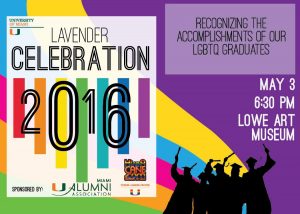
The Lavender Celebration 2016 was sponsored by the Division of Student Affairs, Student Life, Toppel Career Center and Alumni Association to recognize the accomplishments of LGBTQ graduates of the U.
This was before SpectrUM, which was organized in 1992 (under the name Gay, Lesbian and Bisexual Club). Its purpose is to foster pride through education, awareness, advocacy, and social events and to support all members of the LGBTQ+ community and their allies. It’s remarkable to see how far this mission has come, and we look forward to the opportunity of sharing its continuation with future students and researchers.
Stay tuned for announcements about future archival efforts. In an upcoming project in February 2017 we will work with groups such as the Black Alumni Society and United Black Students to curate a full exhibition at Richter Library on UM’s black students and faculty. The exhibition will coincide with the Black Alumni Society’s First Black Graduates Project. We look forward to collaborating with these and other campus organizations to honor their accomplishments.




 I am currently working for the first time to archive a collection of electronic records with my colleague Laura Capell, Head of Digital Production and Electronic Archivist. The commemorable organization of focus is UM’s undergraduate LBGTQ+ group SpectrUM. We will archive messages and e-flyers documenting their organizational efforts in support of UM’s lesbian, bisexual, gay, transgender, queer, and questioning community.
 University of Miami Archives -- Let's Archive It